
Shorelines
Alycia Pirmohamed
Book of the Month: August 2026
Reviewed by Frances Cannon
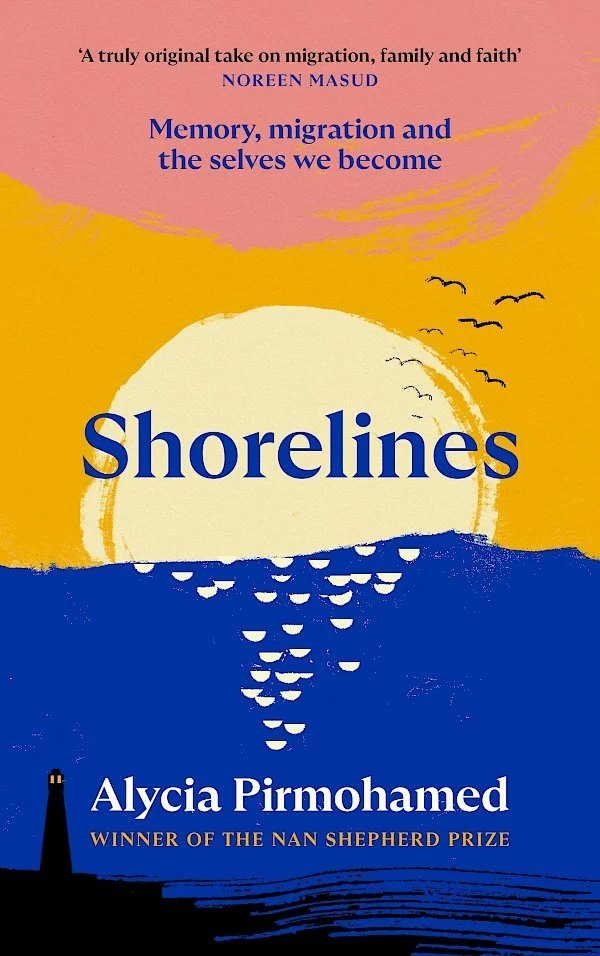
Shorelines by Edinburgh-based author Alycia Pirmohamed is a poet’s memoir, an experimental approach to mapping a life on the page. The book, her first non-fiction work, won the Nan Shepherd Prize. It opens with a lyrical ‘Note on Form,’ comparing the book’s movement to a body entering water. The book’s three sections—Land, Shoreline, and Water—move from narrative solidity into increasingly fluid, experimental forms. Even the first section begins with the unique positioning of two parallel narratives, representing Pirmohamed’s memories from two distinct regions: the Indian Ocean, which she visited with her father as an adult, and a lake in Midwestern Canada, a memory which she can only partially retrieve from the passing of time. The book progresses through various hybrid forms—fragments, field notes, intertextual critique, stream-of-conscious musings, and lineated poetry. These experimentations in self-archival reflect Pirmohamed’s quest for understanding about herself and her place in this world, as well as a radical decolonisation of traditional literary structures.
In this book, identities are porous, borders are blurred, and chronology is fragmented. The layers of displacement experienced by the author, her parents, and her grandparents add to a sense of ephemerality; she describes existing within many diasporas, and ‘intersecting socioeconomic, political, and cultural conditions across multiple nations.’ Pirmohamed’s grandparents immigrated from India to East Africa, where her parents met and subsequently moved to Canada. Pirmohamed moved from Canada, to Oregon, to Scotland. The sense of alienation accumulates with each nested migration. She reflects on a two-year period living in a small rural town in northern Alberta, where her Muslim family felt a greater sense of judgment and isolation, particularly after 9/11, and the absence of a mosque in the region.
Pirmohamed weaves in the insights of other authors and philosophers into her prose: Mary Oliver, Frantz Fanon, Annie Dillard, Rebecca Solnit, Dionne Brand, Sara Ahmed. These quotes and associations positively accentuate and complicate her narrative. For example, in a passage about a dark forest in Stockdorf, Germany, she invokes Carl Phillips who wrote that ‘woods and forests have long been a queer space’ and a ‘natural context for sexual intimacy’. This leads into Pirmohamed’s reflections on her own sexuality and the many ways that her body disobeys societal expectations. Her queerness in particular is ‘often perceived as at odds with’ her ‘Muslim identity.’ One of her early coming-out moments took place in another forest, in Banff National Park, where she felt at ease and free to express her secrets within the ‘wooded sanctuary.’
Pirmohamed writes candidly about her existential dread, depression, and loneliness, weaving these relatable experiences into sensory descriptions of the landscapes that held her through these emotions and experiences. Her description of fog in the Lake District is an effective metaphorical manifestation of her continuous quest for meaning within a fragmented archive and unreliable memories:
What I remember about the earth is stratified with skin memories, which are sometimes also gaps in historic knowledge. Memory and membrane come together in an act of cartography, where landmarks are written in forgotten first languages.
Many passages in the book linger in liminal spaces—Pirmohamed is drawn to shorelines, as the meeting place between land and water, as well as lighthouses, as symbols of self-imposed isolation. A lighthouse in Newhaven, Edinburgh, brings her delight during the dark days of the pandemic. Another lighthouse in Mallorca sends her into a panic attack when she realises that spiritual and poetic revelation cannot be easily achieved through her pilgrimage hike as she had hoped. A lighthouse on the Oregon coast illuminates her need to balance her ‘genuine self’ and her art, ‘without one towering over the other.’ This book succeeds in this goal, balancing her lyrical writing and revealing her true, human experience; the result is thought-provoking, vivid, and innovative. Shorelines refuses fixed boundaries, offering instead a more realistic and interesting multiplicity of selves, homes, histories, and truths.
Shorelines: Memory, Migration and the Selves we Become is published by Canongate
Frances Cannon is a writer, editor, educator, and artist. She is the Mellon Science and Nature Writing Fellow at Kenyon College and is an editorial reader for the Kenyon Review. She has an MFA in creative writing from Iowa and a BA from the University of Vermont.