
A Wee Touch of Goodness
Roxani Krystalli on Agnes Owens
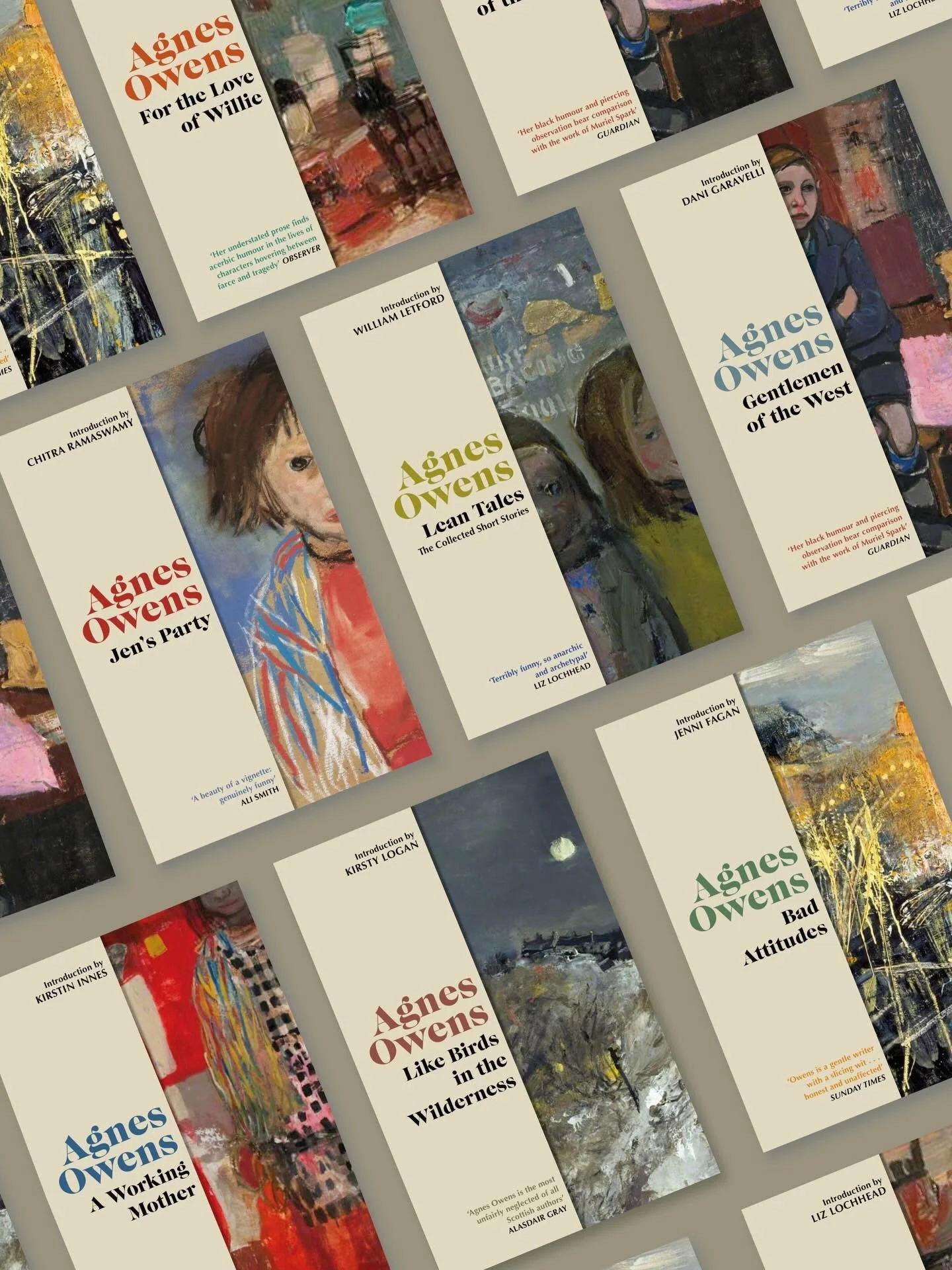
This year Polygon is publishing seven new editions of Agnes Owens’s novels and short stories. Each is introduced by an acclaimed Scottish writer and released in collaboration with the Agnes Owens Archive to mark the centenary of the author’s birth. ‘Agnes Owens was always a writer,’ begins the publisher’s announcement of the reissued editions, ‘although for the majority of her life she was preoccupied with making a living and domesticity.’
This statement reflects a key tension in engaging with Owens’s work in the present day. One avenue of engagement begins with the work itself, with the novels and the stories. Another begins with the story of Owens’s own life, from which those words have sprung. As with many other artists across generations, the concerns of making a living and domesticity werenot separate from Owens’s writing, nor were they mere obstacles to it. Those same concerns were also the kindling for creativity, the drivers of plot, anchors of character, and markers of what animates a life.
Owens’s first novel, Gentlemen of the West (1984), follows the hustle and trials of bricklayer Mac, who is also the protagonist of Like Birds in the Wilderness (1987). On the second page of Gentlemen of the West, Mac is sitting in a hut at a building site, ‘waiting for the rain to stop in order to get on with the vocation of laying the brick.’ This is a typical Owens sentence, its humour stemming from damp bleakness. ‘Maybe it all boils down to the fact that I like bleak situations,’ Owens told Jane Gray in an interview in 2006. ‘But always with humour, you know, bleak and humorous.’
Owens’s protagonists are eager to leave the house and be in the world, even though both the home and the world outside it hold seemingly unlimited potential for hurt. Whether they are teenagers who hope a job at the corner shop can make their days more exciting or women in a psychiatric institution who reminisce about life beyond its walls, these are characters who cling to life by their fingertips. Though her characters struggle, their hardship does not sanctify them. Theirs is not an ennobling suffering. ‘I don’t write about people that are nice people,’ Owens said. ‘They’ve got to be sinners, with a wee touch of goodness here and there, you know.’
By the end of her books, Owens’s characters are sometimes as badly off as they began, if not worse. Her stories gain their momentum not from the possibility of tidy resolution or redemption, but from the constant dance of choices that hold a life together in one moment only for it to unravel in the next.
What makes the unravelling especially compelling is Owens’s style. In A Working Mother(1994), Betty must get a job to provide for her family. Her unemployed husband Adam is struggling with alcohol and with lingering memories of the war. There is enough darknesshere to weigh the novel down, but thanks to Owens’s pacing, the story soars. Some scenes are only a few lines long, alternating between short sentences of dialogue and acerbic internalmonologue. Owens keeps time moving swiftly, which increases the pressure on her characters. Like a poet, she relies on line breaks to deliver the narrative punch, ending a scene on a hint of impending violence, loss, or other devastation.
Take this conversation from A Working Mother, which Betty recalls having with Adam in the moments after they got married:
‘I have never been so happy,’ I said, as we journeyed back in the bus to our lodgings in a room that belonged to Adam’s stepbrother, who I later discovered also hated Adam. ‘Aren’t you happy too?’ I added.
‘I don’t know,’ he said. Then, ‘Sometimes I wish I was back—’
‘Back where?’
‘Back in the army. I suppose it was hell, but at least it wasn’t like this.’
When we next encounter Betty and Adam, a line break later, they are back in the present dayof the novel, sandwiched next to their friend Brendan in a pub. With the line break, however, the doom of the memory lingers.
Owens’s use of adjectives is sparing, which accentuates their effect when they do appear. In the second scene of A Working Mother, Betty visits an employment agency. The sceneconcludes with the image of Betty colliding ‘with the ferret-faced girl on the other side of the door.’ This is murder by adjective. The girl in question never recovers from this characterisation.
In many ways, Owens’s novels are work novels. Some iconic 21st century work novels, like Ling Ma’s Severance or Olga Ravn’s The Employees, are surrealist or apocalyptic, borrowing elements from futuristic science fiction. In Owens’s fiction, both drama and humour derive from the repetitive drudgery of trying to make ends meet. Owens sketches working classpeople who make their lives known not only through the effects of their class positioning, but also through the depiction of the work itself.
As Dani Garavelli observes in the introduction to the new edition, Gentlemen of the West is a book written ‘from the perspective of a hard-ish man about other hard-ish men.’ This interest stays with Owens in her subsequent work, much of which explores the lives of men, at leisure and at work, in moments of charm and in flashes of despair.
Core as masculinity is to Owens’s literary output, her work is too varied to be limited to a single subject matter. Nevertheless, there are some common threads. In the fictional worlds Agnes Owens weaves, no narrator is entirely trustworthy. Her protagonists are often caught in small lies. These relatively benign inconsistencies are introduced in the first few pages of Owens’s slim books, prompting the reader to realise that no universe is too stable to be upended.
It is easy to imagine Owens’s work adapted for the stage, in part because she plays with the implied audience. Her protagonists often narrate a story for a listener, who sometimes reveals themselves to be different than who the reader may have initially imagined. For the Love of Willie (1998)opens with Peggy, a patient in a psychiatric hospital who is writing a book about her life. Peggy narrates the process of writing this book to the woman with whom she shares a room. As Peggy’s story develops, one can picture an actor turning towards the audience to deliver a quick aside. Like the reader, and like an audience member in a theatre, this implied listener of Peggy’s story shapes the story and its telling.
* * *
Born a century ago in Milngavie, Owens did not start writing until her fifties, when she went to a community writing group ‘for the sake of a night out.’ Through this writing group,Owens met Liz Lochhead, James Kelman, and Alasdair Gray, who encouraged her and became enthusiastic champions of her work. Owens had arrived at that writing group withwhat she called a ‘wee poem’ about a forget-me-not. It was Kelman, she told Jane Gray, who advised her to ‘forget the poetry’ and ‘concentrate on the brick-layers!’ The hustle and trials of bricklayer Mac anchor Owens’s first novel, Gentlemen of the West, published when she was fifty-eight years old.
By the time she walked through the door of that Vale of Leven writing group, Owens had raised seven children and held jobs as a cleaner, factory worker, and typist. She had experienced the effects of two World Wars, poverty, grief, and family members’ dependency on alcohol. Owens’s father lost a leg in World War I and died during World War II. Owensacknowledges the hardship in her father’s life without rendering it exceptional—a feature that defines her fiction. ‘I really loved my father,’ Owens told Jane Gray. ‘His life was ruined, but so were a lot of people’s lives ruined.’
Owens’s first husband also fought in the war. On his return, he struggled with alcohol and with traumatic memories. He died when he was 43, after 16 years of marriage. Her second husband ‘wasn’t in any wars,’ in her words, ‘but it seemed that fate followed us and has not been very kind.’ Her youngest son, Patrick, was murdered at the age of 19.
It is tempting, perhaps, to read Owens’s publishing trajectory later in life as a triumph of overcoming or a story about the rewards of persistence. That reading, however, would be antithetical to the relationship to redemption that Owens charts in her fiction. In Owens’s stories, characters struggle, find relief, then struggle some more—sometimes in different ways than whatever had befallen them earlier, sometimes in precisely the same way. What keeps the reader turning the pages is not the possibility of ease, but the resourcefulness and humour with which people keep themselves going.
Biography haunts the reissuing of Agnes Owens’s books. Like many other writers, Owens allowed some of her own experiences to filter into her fiction. She has said, for example, that her son John, who was a bricklayer, was the inspiration for some of the stories in Gentlemen of the West. In A Working Mother, the struggles of a woman married to an alcoholic and trying to make ends meet are not dissimilar from Owens’s account of her first marriage. But, as Kirsty Logan powerfully points out in her introduction to Like Birds in the Wilderness, ‘not everything a writer produces can be laid like tracing paper over their autobiography.’
The risk is that we treat Owens’s books as mere transcripts of her life. Doing so would evacuate them of both the imagination and the craft that writing fiction requires. In reading these books, I found myself wanting Owens to be free of her own biography, to experiencethe pleasure of books that do not stand in the shadow of the writer’s life story.
Owens’s work models a more complex relationship between life experience and storytelling than reading them only as works of autofiction permits. The characters in her stories often play with the boundary between what is real and what is imagined. As For the Love of Willie progresses, Peggy’s characterisation of precisely what kind of book she is writing shifts. She slips between calling it a book about her life, more akin to a memoir, and a novel—an inconsistency that Owens leaves unresolved. Rather than being preoccupied with the impossibility of the question of what is real and what is made up, Owens’s work invites the reader to reckon with the unreliability of truth, the fallibility of memory, and the inventiveness involved in weaving a life.
As Kirstin Innes notes in her introduction to A Working Mother, the origin story of Owens’s writing and the famous authors associated with her publishing trajectory have at times threatened to overshadow her work. The reissuing of Agnes Owens’s books is an opportunity to reconsider the compact between the writer and the reader. What does it mean to be good custodians of both Agnes Owens’s creative work and her life story? Perhaps it means suspending our desire to pin things down, to separate life from fiction. Perhaps it means realising that we can apprehend bleakness without voyeurism, that it is possible to narrate pain and misfortune without rendering them exceptional or totalising. Perhaps it means that, in the middle of the damp bleakness, we can allow ourselves a laugh. Among the many gifts Owens gives us is a glimpse into a scrappy aliveness, an attentiveness to the desire that pulls her characters and readers from one day to the next.
Roxani Krystalli is a Senior Lecturer at the University of St Andrews. Her research, teaching and writing focus on attention, care and place.