
The Queer Bookshelf
Layla McCay
Book of the Month: June 2026
Reviewed by Ryan Vance
A few years ago, myself and a few friends discussed how we’re continually falling short of a self-imposed responsibility: keeping pace with the recent revolution in queer literary representation. We coined a jokey phrase to let ourselves off the hook – no more cultural homework – but we didn’t feel great about it. After all, good queers know their history; if we don’t keep our stories alive, no one else will bother.
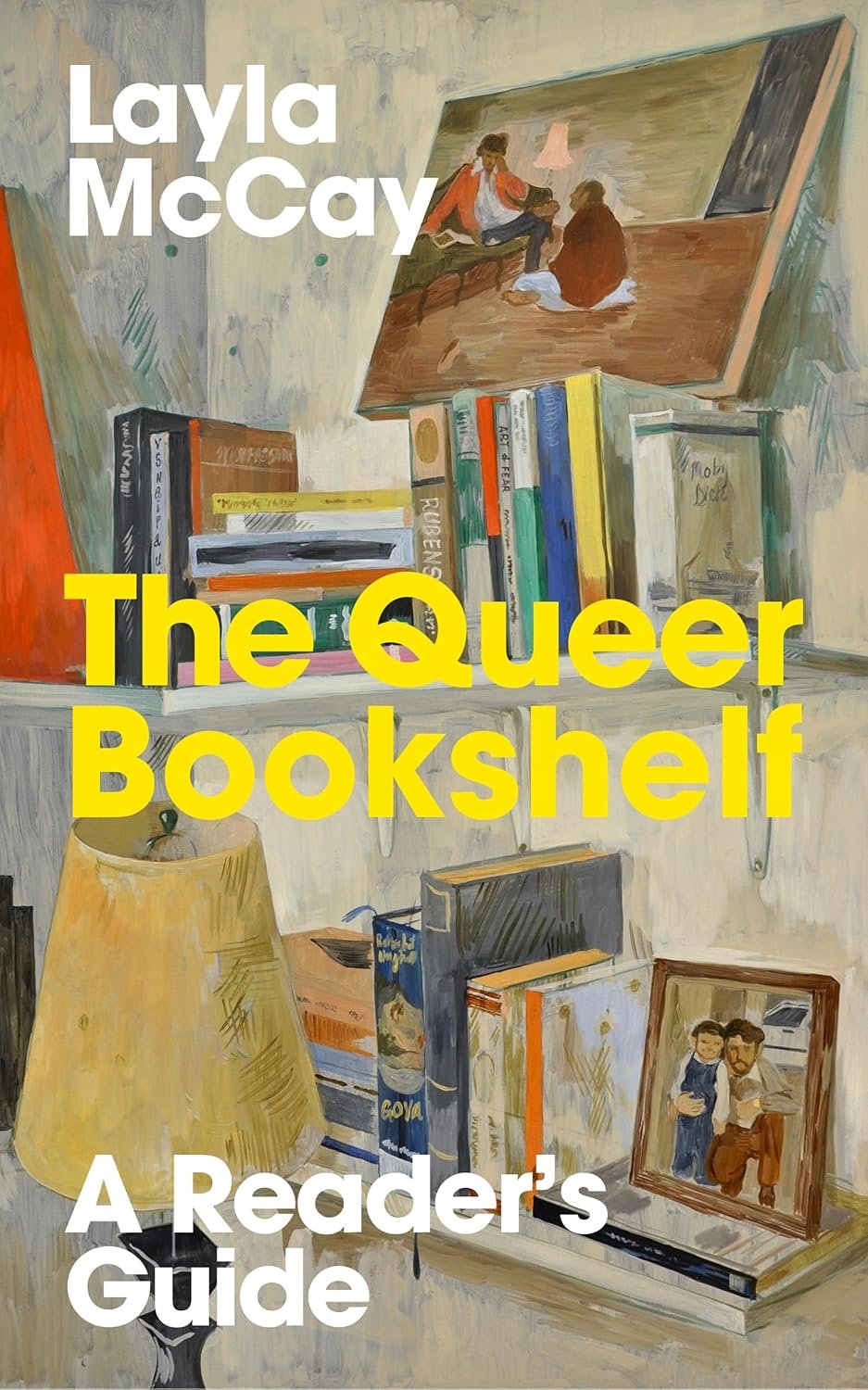
Which is to say, reading The Queer Bookshelf: A Reader’s Guide evokes no shortage of complex emotions. Top of the order is a grubby mix of relief and gratitude, that someone has actually done the homework. It’s a gargantuan task, as Layla McCay observes in her introduction: ‘we’ve shifted from almost zero visibility of queer books to so many that it’s impossible to read them all.’ A smart move, then, to crowdsource recommendations from queer readers and writers who know their stuff, including Damian Barr; Jackie Kay; founder of the Lambda Literary Awards Deacon Maccubbin; booksellers including Jim MacSweeny of London’s Gay’s The Word; and staff of LGBTQ+ archives worldwide. The index runs just short of 700 titles, the majority – though not all, and not all conclusively – written by queer writers. This collective research is impressive, and McCay makes it easy for any work-shy scholar to catch up, with back-of-the-book reading lists organised by sex, sexuality, gender and genre.
But research is only half the work of listing; the other half is curation. The Queer Bookshelf is largely chronological, with chapters devoted to publications pre-1900, all the way to post-millennium. Each tends to open with a brief overview of the Western politics of the era and notable publications in the English language, before expanding to queer books around the world. McCay tackles the first half of this history with aplomb, covering not only early queer classics and curios, but the romances, scandals, tragedies and rivalries of their authors, alongside plenty of personal asides, including a comically visceral dislike of Radclyffe Hall’s The Well of Loneliness. As she catches up with living memory, however, McCay takes a more sober approach, with shorter summaries and fewer opinions. If not for occasional interludes by booksellers divulging first-hand experiences of running queer bookshops, the back half of this history would read very dry indeed.
The Queer Bookshelf also demonstrates a soft spot for Firsts. The first gay man’s memoir. The first lesbian vampire novel. The first intersex memoir. The first Black gay man in fiction. The first lesbian pulp crime. And so on. Curiously, some of these firsts are lacklustre or even antagonistic depictions of queer lives, written by people who weren’t themselves queer – or at least, not open about it. While it’s impossible to retroactively apply identities to the dead, McCay herself frequently raises the question of authentic and inauthentic representation, without settling on a firm answer. Personally, I would have welcomed more recognition that these historic firsts are always only those that we know of. For every inauthentic first, there will have been an authentic depiction that came before, but was censored, forgotten, or unpublished. The inauthentic firsts, meanwhile, often belong to a parallel history of our misrepresentation by others, and I’m not sure I would include any of them on my own queer bookshelf.
Two chapters step outside the chronological framework, and suffer for it. The first ostensibly covers fiction for children and young adults, though quickly moves on to books about queer youth written for adults, then on to young characters who can be read as queer, even though they weren’t written as such. The act of queering texts fills gaps in our history, but it’s always an act of desperation, of hunger. There are times, however, when honouring those absences feels more appropriate than constructing a canon that never truly considered us to begin with. Given queer books for young readers are such a recent phenomenon, it seems a shame not to give them, and their context, the chapter’s full focus.
Then comes the chapter on genre fiction. McCay observes the genre tag can be reductive, drawing a parallel that ‘just as many have mixed feelings about their books being segregated in the LGBTQ+ section’. This chapter segregates the genre books all the same, arguing they contend with history differently than more grounded work. I disagree, not least because a number of the listed genre books receive mentions in the chronological account, where their historicity is more clearly relevant. I also disagree when McCay frames genre work as a way to tell stories where ‘queer characters’ queerness is incidental.’ Nobody’s forcing anyone to write queer characters, but nobody’s writing them accidentally, either. If anything, as McCay points out, ‘having an LGBTQ+ theme is one of the biggest causes of books being censored, banned, or otherwise restricted.’ The fact is, queers are real; if you write about reality, excluding us is a choice; if you write about unreality, you must choose to include us. There is not a single incidental queer in all of fiction, especially not in genre.
However. Of the nearly 700 books mentioned, I’ve only read 35; given McCay’s focus on origins, significance, and legacy, it’s tempting to feel I’ve failed at being a good queer, and should read more widely before I pass comment. That said, scores of authors I’d have expected to feature, don’t. For example, Harry Josephine Giles, the first trans Orcadian woman to win the Arthur C Clarke award with a verse novel written in two languages (that we know of) doesn’t appear. Edwin Morgan, the first Glasgow Poet Laureate and the first Scots Makar, is also absent. The first Scottish queer bookshop Lavender Menace goes unmentioned, as does Category Is, more recent but no less significant. These snubs might be expected of the UK’s London-centric publishing industry, but they are surprising for a compendium of firsts compiled by a Scottish author.
Despite these misgivings, I’m glad The Queer Bookshelf exists. Overall it’s a fair starting point for anyone brand new to reading queerly, and a good reference point for those of us wanting to fill (perhaps significant) gaps in their knowledge. My own to-read list has grown, especially with regard to older, rarer texts I would otherwise never have heard of. I might quibble with some criteria for inclusion, but McCay expects readers’ experiences to differ. A coda invites discussion and disagreement, recognising the impossible task of containing an entire imperfect community narrative within one book.
Ultimately this list functions best as hooks on which to hang our history, and readers will discover their own favourite titbits. Mine included the dozens of UK and US mid-century literary salons that barely lasted a year, and how the drag queen Divine borrowed her name from the protagonist of Jean Genet’s Our Lady of the Flowers. I found myself fascinated by our gradual shift away from semi-autobiographical erotica, as mainstream publishing figured out how to profit from respectable queer representation. Finally, I never knew every UK writer owes the existence of both the Authors’ Licensing and Collecting Society, and the Public Lending Right, to lesbian writer Maureen Duffy. Thanks, Maureen!
Despite the title, this is not the queer bookshelf, simply a queer bookshelf. Good. Queer literature has always existed outwith attempts to canonise it. With any luck – and countless more firsts to come – it will continue to do so.
The Queer Bookshelf: A Readers Guide is out now with Scribe
Ryan Vance is a designer, writer and editor. They published One Man’s Trash (2021) with Lethe Press, and co-edited two anthologies with 404 Ink, We Were Always Here (2019) and Fierce Salvage (2025). They are a member of Gutter’s editorial team.