
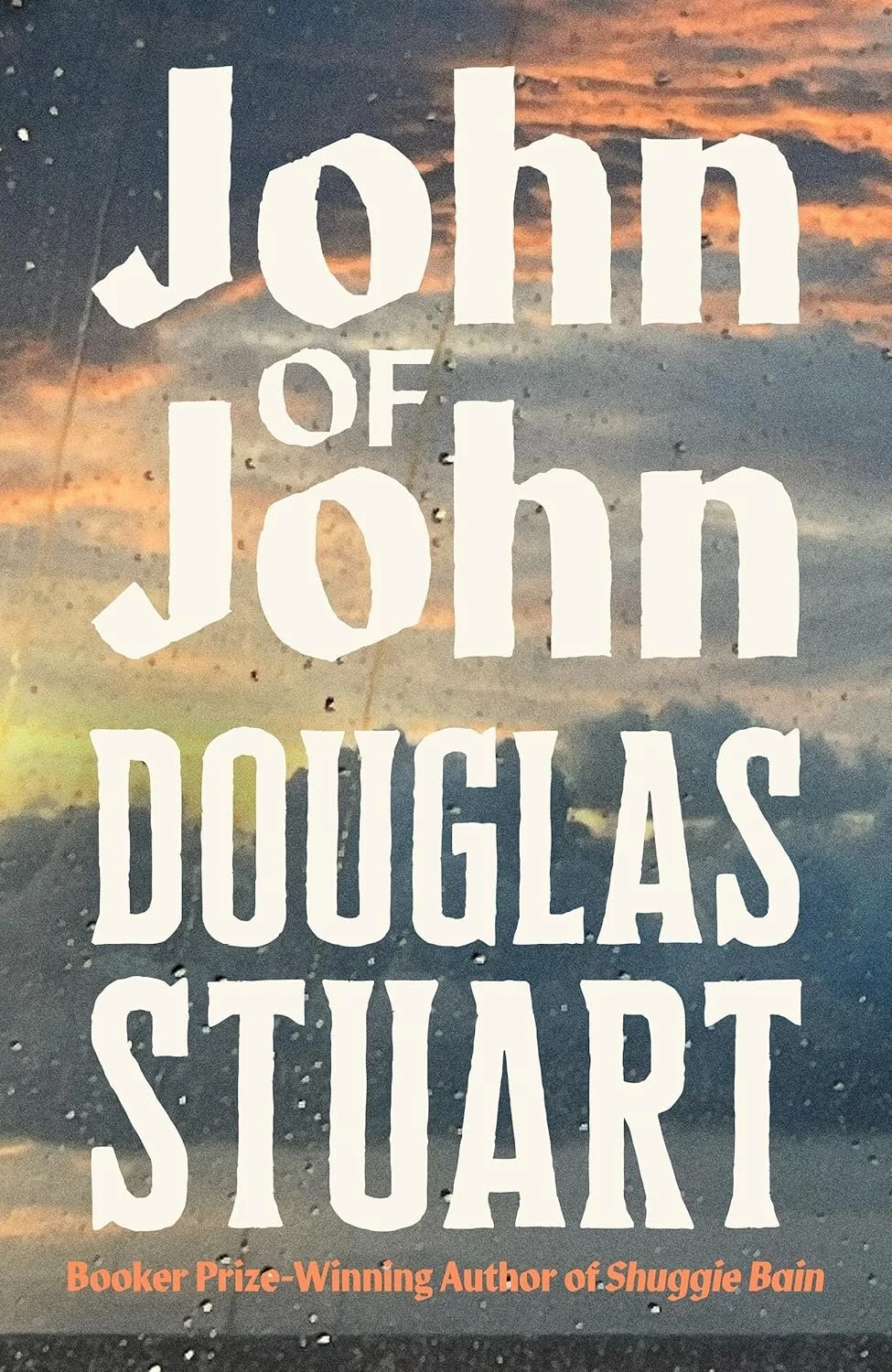
John of John
Douglas Stuart
Book of the Month: May 2026
Reviewed by Laura Baliman
After winning the Booker Prize in 2020, successfully breaking ground within contemporary literary fiction, there may be a sense of pressure on Douglas Stuart’s third novel, John of John. However, no such pressure is evident in this confident, standalone book.
At the opening of the novel, Cal returns home from art college to his father John in the fictional town of Falabay on the Isle of Harris. What unfolds is less of the focused character transformation of Stuart’s previous books and more of a sprawling exploration of an island community. Although the novel begins with Cal’s voice, the perspective is malleable, and through zooming in and out on various characters, we get to know the small but fiery community of Falabay and the secrets the people there hold. With a wide range of intricately nuanced figures, such as Cal’s grandmother Ella, or his childhood best friend Isla, Stuart creates an expansive web of characters in this novel.
One of the most significant characters is Cal’s father, John. He is a tweed weaver, a traditional Harris occupation, which extends as an allegory throughout the novel. Much like one of his woven blankets, the countless threads of the characters, and the islands stories and secrets, produce a rich and intricate tapestry in the book.
In this way, John of John is a departure from the trauma plots of Stuart’s previous novels. Here, there is a greater sense of space created, particularly with imagery of the island. For instance, ‘the wind bully[ing] the waves,’ subtly reflects the troubled dynamics between the characters. This space and slowness is reflective of the rural setting, as opposed to the intensive burn of Shuggie or Mungo’s Glasgow. But even through this quietness, there is a dynamic to it – particularly in the gradual unveiling of secrets in the community. The plot does not have a beginning, middle or end, so much as a spiral that twirls inwards as we dig deeper into the island and its people: who they really are, and who they really love.
The question of the novel is thus not so much focused on stakes, but more on truths – can they find their way out, can they find a way through closed lips, can they escape the centuries-long tradition of hiding yourself even in front of the people you know and love the most? Stuart’s maturity comes through here, in the withholding of truth, the curiosity with which the reader continues to turn the pages in hope of finding the real Cal, the real Harris. We learn not through loud clarity but through colours, textures, glances, frowns. Stuart’s venture towards the quieter, the hidden, and the unspoken show a greater development of his talents. In John of John, Stuart still attends to the difficult and serious themes of his previous novels, but with a softer touch and with a radiant mix of the divine and the mundane: ‘God is here.’ ‘Does he want tea?’
John of John is published by Picador
Laura Baliman is an Edinburgh-based freelance writer whose fiction, reviews, essays, art-writing, and criticism appear or are forthcoming in TLS, The London Magazine, SICK, Ache, Poetry Wales, The Skinny, Art UK, Disability Arts Online, Gypsophila, Paloma and Gutter. She is Poetry Editor for The Selkie and won an Edinburgh Art Festival Emerging Writers Award in 2023.