
The Apothecary by the Sea
Victoria Bennett
Book of the Month: April 2026
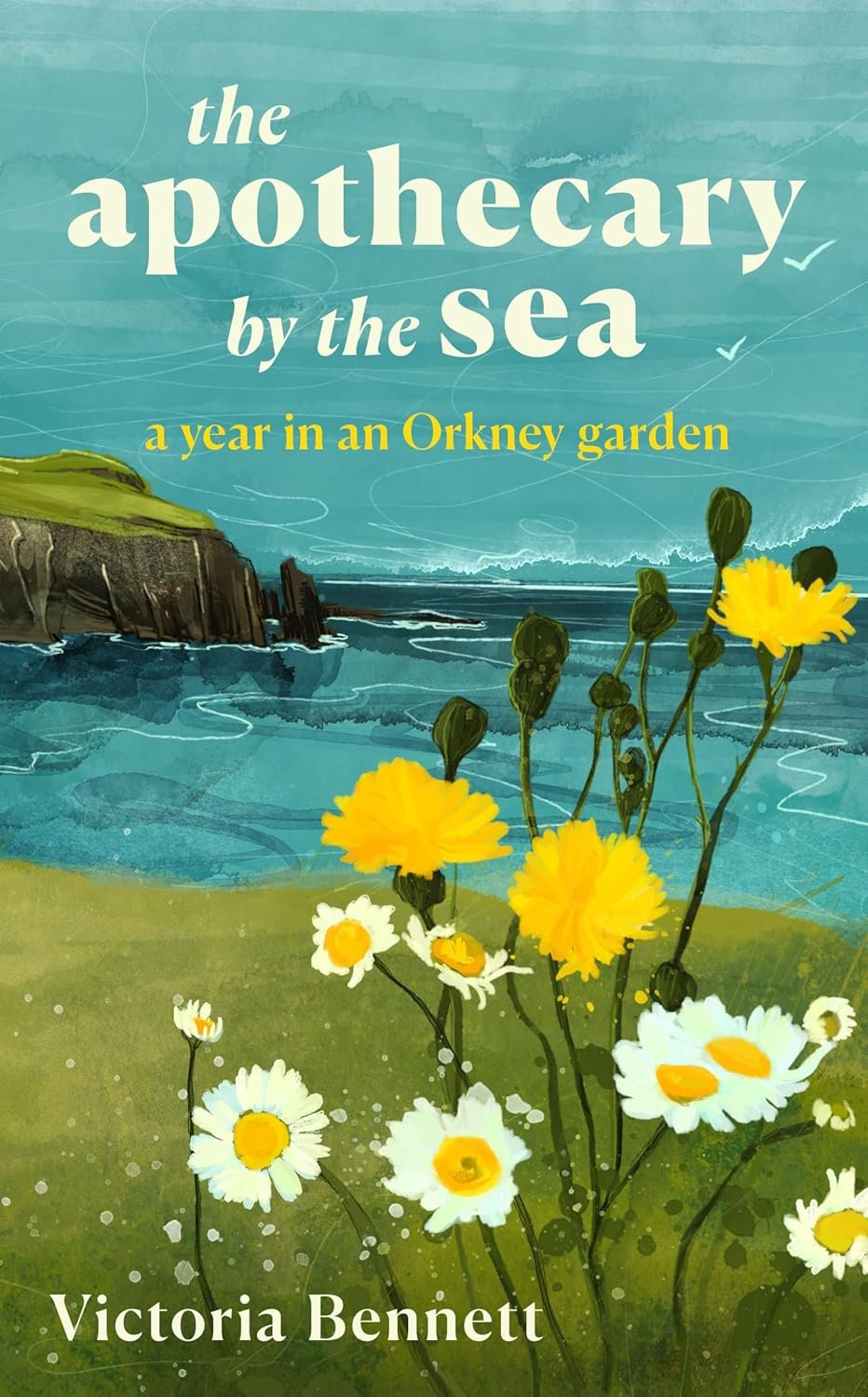
Reviewed by Jemma Neville
The world is in perpetual crisis. And yet, in backyards and at kitchen tables, mid-life women are doing what we have always done in times of personal or global churn. We tend to all that is cyclical and hopeful: plants and people. Soil and soul. And what better place to turn to for spiritual connection to nature than Orkney, which is where Victoria Bennett’s new memoir – come herbal inventory – The Apothecary by the Sea sets seed.
Consistently rated as one of the best places for children to grow up, Orkney is a storied land, both ancient and living. Bennett’s living story begins as all things do, pushing up through the dark of winter, as she and her family relocate from Cumbria to St Margaret’s Hope, Orkney. Harbour-loupers or blow-ins from the mainland, she quips, quick to acknowledge putting down new roots.
This is a book of micro-essays, sectioned by seasonal rhythms: first light, simmer dim, gathering in, and returning winter. The author’s husband, artist Adam Clarke, adds texture with illustrations acting like pressed flower markers in between chapters. It reads as though an alternative almanac or commonplace book, in the sense that the essays can be standalone, or one narrative. Each opens with the name and habitat of a particular plant. We are given the common English, Latin and Orcadian names. ‘Yarrow / achillea millefolium / meely follies, tea flooer’. The prose that follows doesn’t much connect to the plant but the tone is one of intimate possibility. ‘This knowledge is pressing to our ears once more, like the dandelion that refuses to be done, as more and more people come back to the plants that grow wild.’
In urban Scotland, it seems that every photo-friendly plate is adorned with fermented garnishes skimmed from a rockpool. Foraging in the wild has become the new going out-out. And supermarkets label products plant-based, despite everything, everywhere on Planet Earth, having been ever thus. Naturally, the plants featured in Apothecary by the Sea tend toward those preferring the salty, exposed soil of islands – thrift, scurvygrass, wood sage, sea campion. In the botanical roll-call of uses, every specimen sounds more nourishing, more essential to longevity, than the next, and I find myself wanting to grind, infuse and inhale the lot in a oner.
However, Bennett is the real deal – skilled in making balms, tinctures and brews. In the ebb and flow of nature-writing as a genre, garden memoirs abound but few are like this, cultivated in a small, scrubby patch with little or no budget, and therefore relatable. ‘This matters, it [the garden] says – this flower, this tree, this seed, this small patch of land.’
Like her previous, All My Wild Mothers, the author and her publisher stress that the contents cannot be relied upon for self-diagnosis or treatment. The term apothecary is used lightly, ‘folk medicine’, she calls it. I would call her writing dialectic, as in challenging herself and the reader to stay curious.
And I do. To gather and preserve things (time?) matters to mothers.
‘“Where do you stay?” the stranger asks. “Here,” I reply. Close to where the wild things grow. In Hope.’
Released in April to coincide with the flourishing of Spring, I recommend you also stay a while with the gently determined The Apothecary by the Sea.
The Apothecary by the Sea is published by Elliot & Thompson
Jemma Neville is an author, journalist and gardener.