
The Cut Up
Louise Welsh
Book of the Month: January 2026
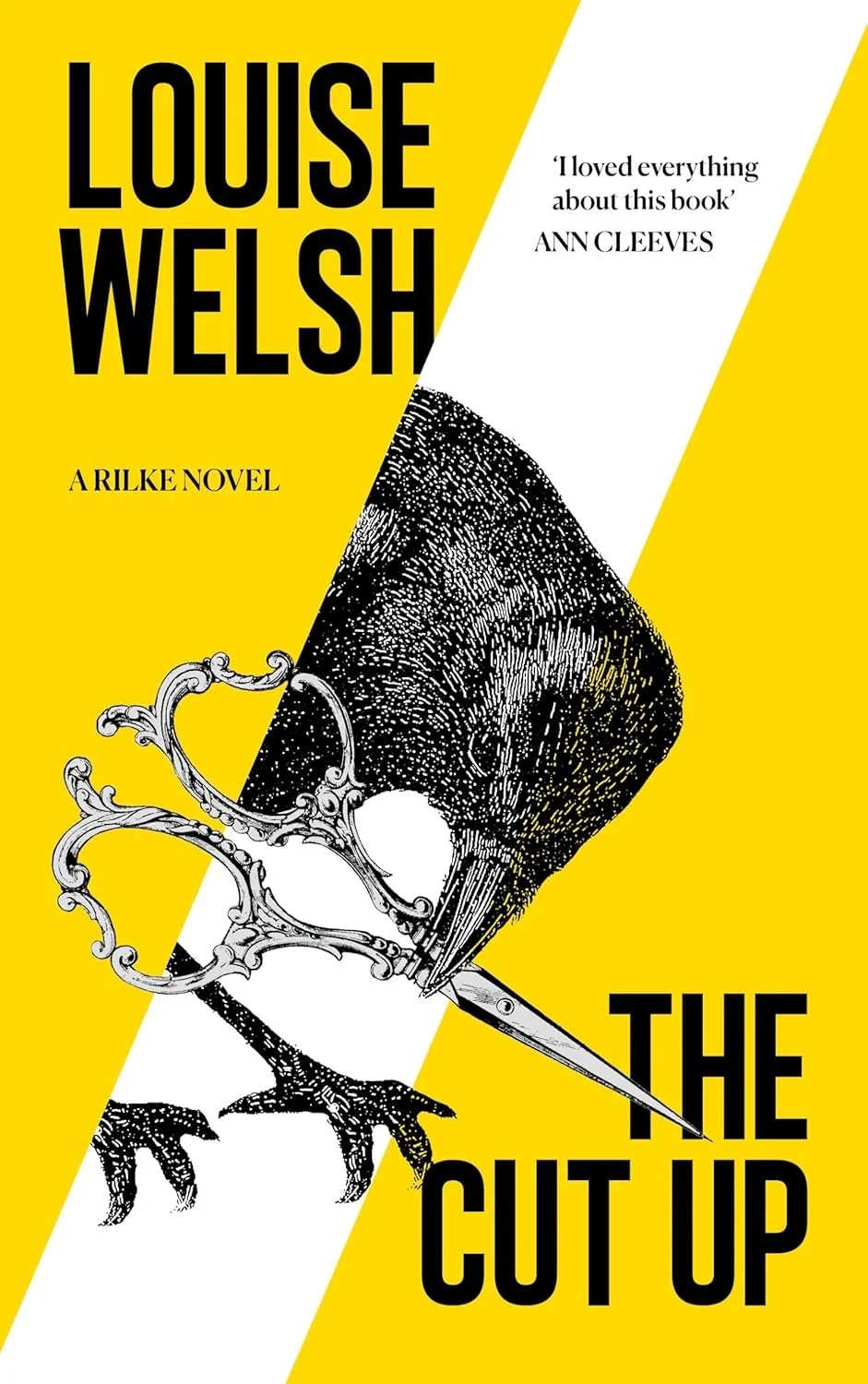
Reviewed by Louise Hutcheson
The Cut Up is the third Rilke novel from Louise Welsh, following her outstanding debut The Cutting Room and its sequel, The Second Cut. The novel can be read as a standalone, but it’s worth delving into Rilke’s Glasgow in all its depth before this third (and possibly final?) investigation unfolds.
Glasgow is indeed vividly rendered; all dark doorways and dreich rainfall, sleaze and drugs and antique auctions. And of course, there’s a body.
Rilke's immediate impulse is typical of the morally dubious, enigmatic auctioneer: tender enough at heart to lay his coat over the body of a man he only faintly knows, but not morally divine enough to think twice about removing the murder weapon that might just implicate his boss before he hails the boys in blue. The dead man is Mandy Manderson, and the Victorian hat pin buried deep in his eye socket was last seen in the hair of Rilke’s boss at Bowery Auctions. Rilke likes his boss, but he doesn't particularly like Manderson, and it’s with Rose Bowery’s welfare in mind that he begins his investigation.
Rilke's dichotic personality is well matched by the supporting threads of the novel – there’s drug kingpin Ray ‘Razzle’ Diamond, who’s running his own investigation into historic abuse at a Glasgow borstal, and the recently incarcerated Les, who’s back on the streets causing Rilke trouble and getting his silver tracksuit bottoms in a knot over the exploitation of a young woman. The bad men aren’t all bad, but we do have a crooked cop and a few questionable antiques collectors to offset them.
The various threads and cavalcade of characters collide into a satisfying enough climax, though the book does suffer slightly from a ‘coincidence problem’: just what is the cosmic likelihood that all three of these disparate plots coalesce so neatly? It’s a symptom of a procedural that’s not a police procedural – drawing together the contingent parts when you have an auctioneer instead of a detective at the centre is simply improbable, and that’s mostly alright, but only because of Welsh’s skill. Her vivid characters, sharp dialogue and the fact she’s able to make us care about an array of weirdos and bad guys means it’s easier to forgive some of the silliness. In the hands of a lesser writer, it would be plain ridiculous.
It's not clear whether this is the last we'll see of Rilke. If it’s his last hurrah, we will wave him off fondly. If he’s to return, he will undoubtedly be welcomed, though we may need to suspend our disbelief on the ubiquity of murders one auctioneer can find himself embroiled in.
The Cut Up is published by Canongate Books
Louise Hutcheson has a PhD in Scottish Literature from the University of Glasgow. She works in broadcast and digital media and is a freelance editor who has edited a number of crime novels and other fiction. Her first book is The Paper Cell.