
Symphonic
Jim Crumley
Book of the Month: February 2026
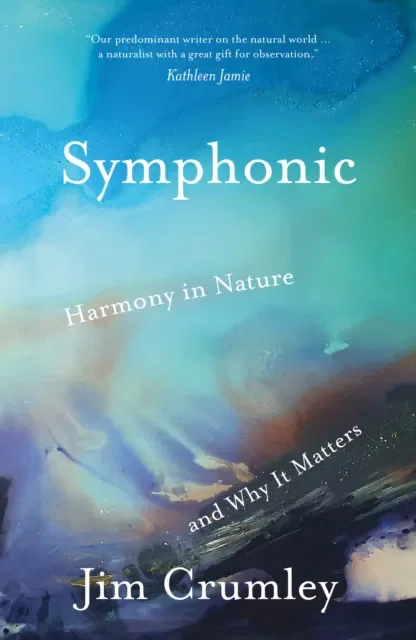
Reviewed by Malachy Tallack
Jim Crumley is that rare thing: a superb nature writer who celebrates the label without qualms, and whose reputation has, nevertheless, been untroubled by either the rise or the fall in the genre’s fortunes.
During the past dozen years or so, the popularity of nature writing among readers grew rapidly. At its peak, UK publishers were churning out books that followed one or another of a small number of nature-related recipes. Too often, these books weren’t much good, and the avalanche of mediocrity might well account for what seems now an equally speedy decline.
Some authors for whom nature had long been their subject were raised high by this publishing wave; others were not. Crumley is in the latter camp. I could hazard guesses as to why his name is rarely mentioned among the greats of the genre, but the important thing is that it ought to be.
Crumley brings three things to each of his many books. He brings knowledge, first of all: a naturalist’s knowhow and an unquenchable eagerness to find out more. He brings a sharpness of the senses: an ability to see and to hear what almost anyone else would miss. And he brings, too, a prose style that is precise, vivid, often surprising, and entirely his own. He is, I think, among the best Scottish writers at work today.
Consider this, the opening line from the first chapter of Symphonic: ‘I dream of Everest. Who doesn’t who loves mountains?’ That question – almost archaic, somehow, in its construction, and yet perfectly weighted. Then, a few lines later: ‘it was always the company of mountains that beckoned; it was their take on the world I sought.’ Pleasing to the ear as well as to the mind, as Crumley’s sentences so often are. And there’s what I mean by surprising: not ‘perspective,’ to which most writers might have reached, but ‘take’, which does so much more.
Subtitled ‘harmony in nature and why it matters,’ Symphonic pulls together short chapters on seemingly disparate subjects: coal tits nesting in a broch, Sibelius, John Muir, the songs of humpback whales, big trees and small ones, and a smattering of poems. Crumley enacts harmony by finding resonances between the different places and creatures he writes about. Images recur; ideas echo. There is an element of whiplash created by the brevity of each piece, and the leaps taken between them, but Crumley inspires trust. When he changes direction, I’m glad to follow.
As the book progresses, there is the sense of things not just moving forward but building. ‘Symphonic’, as the prologue makes clear, means ‘the interweaving of themes or harmonious arrangements,’ and this is the effect that Crumley is trying to create. The book doesn’t read as experimental, it’s far too down-to-earth, in the best of ways, for that. But it’s clear the author is trying to do something a little different, structurally, with his material. And he succeeds.
If you want to read Jim Crumley at his finest – condensed pretty much to perfection – I’d recommend one of the short ‘Encounters in the Wild’ series of books, which Saraband will republish in May this year. Badger is a real favourite of mine – Fox, too – but you can’t go wrong with any of them.
The best nature writing can make you look at the world differently; it can be revelatory, wonder-inducing. The best nature writing surprises, illuminating ideas, connections and, yes, harmonies that the reader might never have reached themselves. If you want the best nature writing, you should read Jim Crumley.
Symphonic is published by Saraband Books.
Malachy Tallack is the author of five books, and is Managing Editor of Gutter.