
Afterlife
Polly Clark
Book of the Month: February 2026
Reviewed by Iona Lee
This is, in a sense, a self-conscious, poetic, Krapp’s Last Tape of a book. The present interrogates the past; selections from three of Clark’s extant poetry collections (Kiss, 2000; Take Me With You, 2005; and Farewell My Lovely, 2009) conspire to provide a sort of culmination: an Afterlife, the title of this new collection.
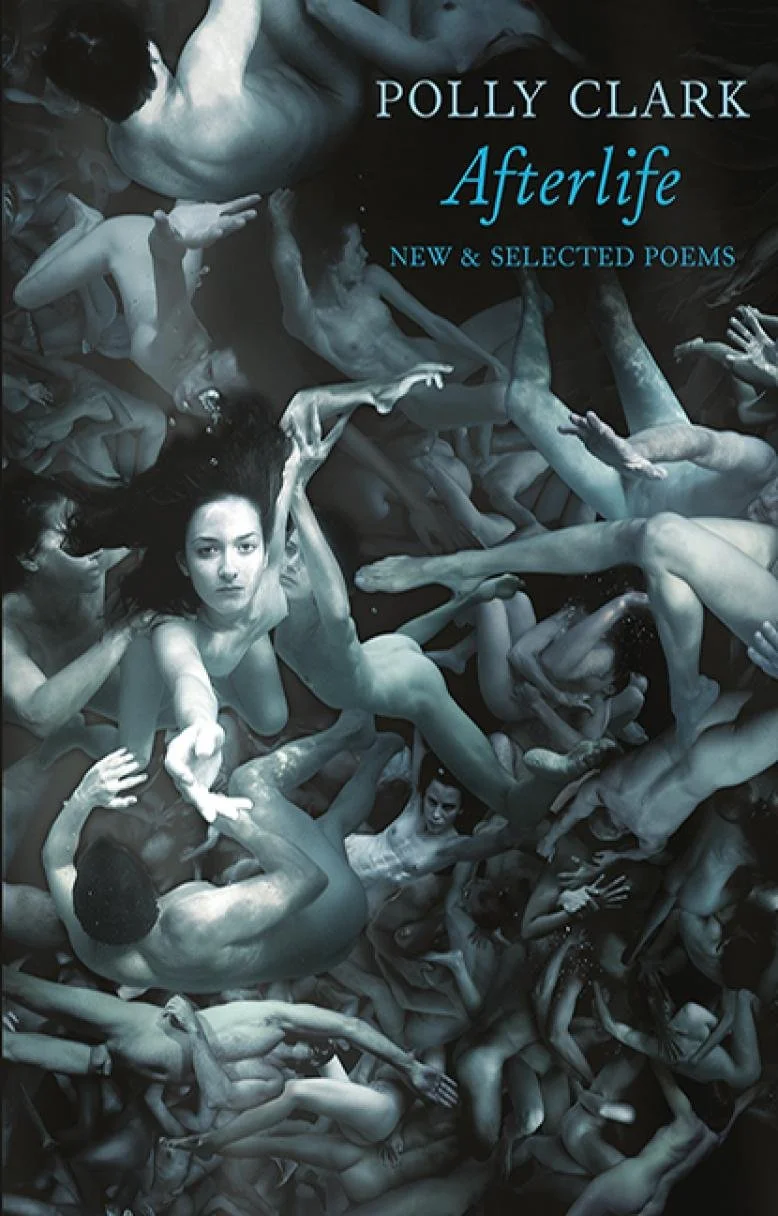
The poems in Afterlife live in the surreal space strung between life and death. They have been set adrift upon water, where they circle the apprehension of what comes next. Most strikingly, in ‘Port Meadow’, the reader is invited to imagine ‘waking on the battlefield… in a promised heaven’. ‘My Shrödinger’ embodies those same amphibologies: alive and dead simultaneously, the poet’s existence defined by how she is perceived by a man. ‘My Father's Ghost’ beautifully reframes grief as a condition which, conversely, makes ghosts of the living, while in ‘Interrogation’, Clark writes that ‘Everything under the sun is either living or dead,’ granting both states the same weight of reality, mirroring Bashō’s sense of poet and subject as ‘a ghost and a ghost to be.’
Nothing is ever still in ‘Afterlife’. The poems are in flux and words turn expertly into new worlds and timelines. A girl and a tiger trade bodies. Love letters translate into smoke. Characters appear in multiple pieces, returning transformed. The plumber who stars in the earthily comic-opera of excreta, ‘Drain’ – a poem about the ‘stuff that didn’t go to hell’ making its loathly return – has died by the time of ‘Crossing’, where the memory of him ferries Clark across a river redolent of the Styx. The name ‘David’ commences all of her mother’s sentences in ‘The Pet Man’, echoing, whether intentionally or not, Michelangelo’s David, referenced also in the collection’s opening poem, ‘Sculpture’: the perfect man that Clark is trying desperately to chip from a ‘lump of cold relationship’.
Later, in ‘Birdsong’:
I thought about my father. He followed me
all my life, even when he was dead,
becoming man after man, staying as that man
until he’d eaten me up, then moving on.
The father in these poems begins to feel like the hidden form within the stone, one that the poet is either working towards or against. ‘Sculpture’ explores not only a woman’s effort to romanticise a past relationship, but also the impulse to treat life in much the same way: as material to be shaped into story. This is most apparent when the poem is read in its context as the prologue to a retrospective. It closes with the lines: ‘We are living, somewhere, deep in this work. It’s what I’m made for, though I longed for more.’ This, I feel, defines the primary haunting of ‘Afterlife’: the life of the writer, and the persistent attempt to give solidity to the intangible, to call those who have been lost back into some form of being.
Alongside the father-ghost following Clark through these latest poems is the recurring figure of a little girl, who can be read alternatively as the poet’s own daughter, as the children that didn’t come to term, or as the child-version of the poet herself.
The theme of insecurity and existentialism inherent in motherhood runs through the collection: plucking a soul out of obscurity and sending it out into a dangerous world. ‘That Night A Storm’ features the beautiful line: ‘I lifted out my heart and set it free upon the water like Moses in his basket’, while in ‘Heaven’ the poet plays God and creates a world for her child in which an afterlife definitely exists, reassuring her that ‘everyone you love will be there.’
This is a fine collection: funny, feminine, and violent; confessional yet mysterious; and the journey into Polly Clark’s poetic past, the way in which she edits her own antecedence, rewards careful reading.
Afterlife is published by Bloodaxe Books
Iona Lee is a writer from Edinburgh whose work encompasses poetry, visual art, music, and live performance. Her critically acclaimed debut poetry collection, Anamnesis (Polygon, 2023), was shortlisted for the Edwin Morgan Award and won the Somerset Maugham Award. In 2024, Iona published What I Love About a Cloud Is Its Unpredictability (Trickhouse Press), a collection of visual and concrete poetry created through interactions with the geolocation software what3words. Iona holds an MFA in Art & Humanities, and her work engages with themes of magic, media, truth and storytelling, art and artifice, memory, and other hauntings.