
Rebecca Ferrier
Interview by Zain Rishi
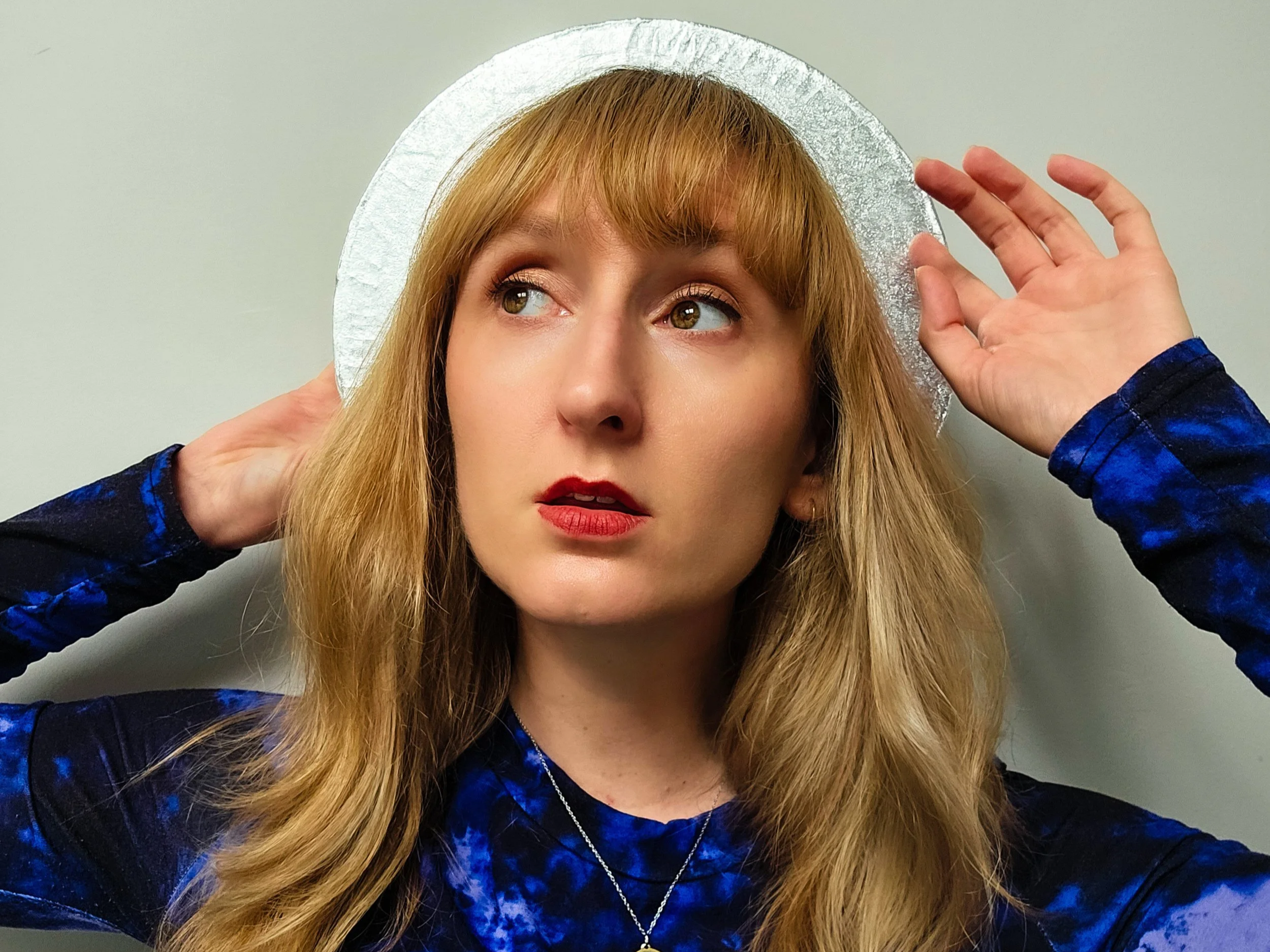
Rebecca Ferrier’s short stories, essays and poetry have featured in numerous journals and magazines. Her writing explores themes around nature, folklore, chronic illness and outsiders, often challenging class and patriarchal structures. Rebecca currently lives in Scotland while maintaining close ties to the South West, where she was born. The Salt Bind is her first novel. She spoke with Gutter Guest Editor Zain Rishi at her flat in Edinburgh over tea and some dark chocolate Leibniz biscuits.
Zain Rishi: I want to start by asking you what your inspiration was for your debut novel, The Salt Bind?
Rebecca Ferrier: I wanted to write a book that featured chronic illness at its core, and also to write about landscape. My dad’s family is from Aberdeen and my mum’s side is from South West England. She grew up hearing stories about her Cornish ancestors and did a lot of archival research, looking at censuses and trying to figure out the truth of what she had been told.
She discovered a history of agricultural labourers who were so poor they had to rent their own ploughs, maidservants to the famous Cornish Spry family, and poachers along the River Avon who stole from the Talbots of Lacock Abbe. These were for the most part normal people just trying to survive, so it was fascinating to see these records, often only from the perspective of wealthy people who lived on to tell their stories.
I’ve always felt a connection to Cornwall. We’ve gone on family holidays there for more than a decade, often to Towan Beach. It’s stunning. I think my heart is in two places: the Highlands where my grandparents lived, and the rugged, Cornish coastline. Being able to go back to Portscatho – my novel’s setting – after lockdowns was so therapeutic, especially because I was bedbound for a while and found comfort in making up different worlds and stories. This book is what came of it.
ZR: That’s so interesting to hear about your connection to the history and landscape itself. Can you tell me about what inspired you to focus the story on two sisters?
RF: It started out as a very different book, focusing on the fishing community, and then it turned into a story about Kensa and Elowen.
I’d been missing my brother. We had a very insular childhood where it was just us for a lot of the time. Being a Forces kid, you move around a lot and rely on that one family bubble. The cast of friends changes. The classrooms are all so different. You have to play catch-up to learn what topics people are doing at school.
The consistency in all of this was my brother. He was the person that heard my first stories. It was really important for me to get that sibling bond on the page, but also to write about it with a bit more anger by making Kensa the black sheep of the family.
Kensa is the girl I could never be. She’s so outspoken, aggressive, and also a bit of a bully. But she’s also so vulnerable and reminds me of the girls I grew up with as a teenager in the Midlands. They had to learn to be more independent than they should have been from a young age. Elowen definitely also has a bit of a superiority complex. She hides a lot of things. Growing up with a sibling in close proximity, you’re not always honest, but you presume the person living with you will know you. I wanted to show the vulnerability of that carer dynamic with Kensa looking after Elowen, even though Elowen doesn’t necessarily want to be helped. It meant holding up a mirror to each of them. They have a lack of understanding of each other that is driven by the things they won’t confront.
ZR: That really comes across in the writing. Kensa’s character also becomes so interesting when you think about it from the perspective of, um, I don’t actually know how to pronounce her name … is it ‘Isold’ or ‘Isolda’?
RF: It’s both! Most people have tended to pronounce it ‘Isolda’. Elowen’s name is pronounced differently in Cornish too. There’s going to be so many different ways that people pronounce everything, but I’m letting people settle on what they want. I don’t want to start another ‘Babel’ or ‘Babble’ argument haha.
ZR: Haha okay let’s go with ‘Isolda’. I found that dynamic between them to be so complex, because suddenly Kensa is dependent on Isolde and no longer in the position of being Elowen’s carer.
RF: I wanted to add age to the coming of age novel. I feel like as a woman you’re always going to change and morph into something new, and I’ve always been very interested in those monstrous-feminine themes.
Isolde is the woman I’d love to be. She’s free and interesting and funny, and at the same time not exactly warm. I’ve been guided by the older women in my life, so it was natural I was going to write about one. When our society glamourises youth so much, it feels like there isn’t always a place for a mature woman in stories. They are often unfairly relegated to being someone knitting on a chair in the corner. I wanted someone who was alive and bold and fascinating.
I also loved Terry Pratchett growing up. I was at a holiday cottage with my family when I saw Equal Rites on the bookshelf. It was brilliant and I blasted through as many of his books as I could. I was so inspired by characters like Granny Weatherwax who definitely had a role in informing who Isolde was.
ZR: She’s such an integral part of the story. I read that you actually based her cottage on a lot of things you saw at Boscastle’s witch museum? I loved all of the charms around her house, especially the onions. Can we please talk about the onions?
RF: Yes, I love the onions! I’m so inspired by stories about witches, and also the modern day equivalent where they talk about how the girls that bullied you at high school either turn into nurses or teachers. I think that’s quite unfair! I wanted to take that trope and subvert it for Kensa, who has a healing role in village.
I created a witch’s cottage that felt damp and nettle-ridden. During lockdown, I got into watching videos of people making clothes from nettle fibres and basket weaving. I was part of this online community where I would lurk in the forums, quietly fascinated by these women who were trying to save old crafts. At the time, ‘trad-wife’ content was having a moment, but I was more into these communities who were resurrecting real traditional practices.
The Museum of Witchcraft and Magic in Boscastle is gorgeous. It’s got fertility charms and little poppet dolls everywhere. I was also inspired by another contributor to Gutter, Alice Tarbuck, who has a book called A Spell in the Wild which goes through a year and six centuries of magic. She explores our relationship to magic, including those elements of superstition, some of which we still have, like a lucky pair of pants or a talisman we keep with us.
So I guess for me, magic isn’t something we gave up on in our culture. It’s something that we all know and still live around – a little like onions (only we cook with those now and tend not to tell fortunes).
ZR: The other thing that really drew me into the world was the sense of community. You mentioned that you spent a bit of time doing research in Portscatho. How did you approach the challenge of writing about a wider network of people?
RF: I’ve fallen into the role of observing a lot in my life, which feeds into my storytelling. The town where the book is set, Portscatho, is a community that really takes pride in its history. There’s the Gerrans Parish Heritage Museum at the very top of the hill. It’s run by these great volunteers who have a range of archives, including details of how people died, smuggling records, and even lists of local shipwrecks.
I did a lot of my research there and online. There are many writers who have told stories about this world, Daphne du Maurier for example. I’m even named Rebecca because of the book Rebecca, thanks Mum! Her portrayals of Cornwall are so gothic and beautiful. When I was young, my family lived in Germany before moving to the UK, and I was used to these very flat landscapes. Moving to the more rugged countryside was so exciting for that reason – I was suddenly in a world I only knew from television.
There was one night, standing outside the St Mawes Sailing Club, where I could hear the fishermen singing sea shanties. It was dazzling. Because I’ve lived in these very disjointed communities, moving around so much as a child, I’m fascinated by community and what it would mean to live in a place long enough that you knew everyone. Scotland is the longest place I’ve lived and so I’m always curious about what it means to belong.
ZR: That’s another thing I’ve found so lovely when reading about your journey: hearing just how much you’ve got from Scotland. I read that your incredible chapter about the Weaver actually took inspiration from a trip you did to Moniack Mhor when you won the Bridge Award. Can you say a bit about that experience?
RF: If you’re going to write about death in a novel, you need to tell the reader what death is, especially if there’s any genre element of that world which is fantastical. So I had to find a way to put death on the page.
The Weaver is a very isolated, misfit character. He was ostracized from his community and ended up putting his love into his flock of sheep. Having Kensa experience death laid the important groundwork for what happens in the novel, and how she ends up responding to it.
In contrast, Moniack Mhor gave me new life. I’d never been in a room with a bunch of writers, let alone so many who taught writing for a living. Hearing their support for my work was the encouragement that I needed at a time when I was still recovering from illness. I was trying to understand what my body could do, and I suddenly found a way to express myself.
I think when we express ourselves as writers, it’s not because we want to shout into this echo chamber. We want other people to call back – and at Moniack Mhor they did.
I was also part of the DeathWrites Network at the University of Glasgow: a group of writers who get together to speak about death, dying and illness. Through the initiative, I talked to other creatives who were also writing about grief, which informed a lot of how I explored it in The Salt Bind.
ZR: I’m curious that you mentioned genre as well, because this book seems to really live between genres such as historical fiction, folk horror and fantasy. What has genre meant for you in your work, and what would you say to new writers who are trying to write between genres like you’ve done?
RF: I feel like we impose genre because it’s easier for marketing. There will be some people that love their pure genre fantasy, and I love that for them. I grew up with quite a wide reading taste. All these elements of the book that I’ve tapped into are the elements of things that I find interesting.
I wrote the book that I wanted to read at the time, blocking out all the noise and not looking at the market. I was only thinking about how I could tell this story in a way that resonated with the themes I wanted to explore. Every story, no matter what it is, has this ring of truth to it – something the author is trying to communicate. I think that’s the part that can cross genres.
If you’re a writer, it’s your job to just write and trust that the pieces will fall into place. You might not know what form it will take until it’s finished, but if something moves you enough that you’re going to spend hours, days, years of your life tapping away at a keyboard, it has to be true to you.
ZR: I read in the afterword that you also worked a bit with the Cornish Language Programme to perfect the linguistic elements of the novel?
RF: Yes, that was really important to me. A while ago, I did a poetry residency with a group of Gaelic speakers. I was on this beautiful walk where a friend of mine talked me through all of the Gaelic names for flowers as we went through the landscape. There was something really special about being able to connect to those particular words while wandering the Scottish Highlands.
I knew there was no way I was going to write about Cornwall and not have the Cornish language in there. In the time the story is set, the language is not around anymore. However, because it’s fantasy, I had the liberty of being able to write it into the world.
We’ve lost a lot of knowledge about the Cornish language, so my own rendition will never be historically accurate. But being able to work with the Cornish Council and get their guidance was such a privilege. It was completely free, and they offer their services to boost people’s awareness and knowledge.
Naming as a convention is really fascinating to me. There are so many poets who use naming in their work. Poetry inspired me to consider the language that we use, and getting to include the Cornish language meant the book felt more alive and real to me.
ZR: That’s wonderful. I read that you’ve also been working on a short story collection. In fact, one of those stories, The Beloved Wife, appeared in Issue 30 of Gutter in August 2024. What has the process of writing a short story collection been like? And also, what have Gutter and the Scottish literature scene more widely leant to your creative journey?
RF: Scotland has given me a home and a sense of what a community can be. It’s provided me with funding, great healthcare, and the chance to explore my craft and become a writer. Gutter was definitely a part of that journey. I was told by another author that if you’ve got a piece in Gutter, then you’ve kind of made it. It has such an eclectic mix of work and crosses genres in many ways.
I was really touched to have such an oddball piece selected, which played on the folklore and rural elements that I’m interested in. Gutter took a chance on something really strange and risky by picking it. It’s so important for a young writer especially to get a sense of encouragement to keep going.
It’s hard to sell a short story collection in this economy, so it’s still in progress. Much of it was written and read aloud at Moniack Mhor. It’s folk horror, and very surrealist – like imagine if Angela Carter and Carmen Maria Machado had a baby (horrifying).
My short stories give me the freedom to explore things that are really bizarre, often through magical realism. Questions like what does it mean to be a woman, what does it mean to have agency, and what does it mean when communities unravel. I want it to feel contemporary but also historical.
ZR: We look forward to it! On the topic of future books, you’ve mentioned that The Salt Bind is part of a duology. Can you tell us what it’s been like working on the second book, The Cursed Tide?
RF: People often talk about second book syndrome. I’m part of a debut authors group which is a sort of unofficial union of writers who were published in 2025. We have this large WhatsApp group, go along to each other’s events, write our second books together, and even sometimes put each other up for the night in our respective cities.
The support of these writers has been just phenomenal. Putting out your debut book is such a strange journey to be on, and different for everyone. Publishing is a very vague industry, so having other people share their guidance is so affirming.
Having a world established for my second book – The Cursed Tide – was such a help. I knew I couldn’t leave Kensa yet, so I was very glad to have a two-book deal. I felt like it would have been a waste if I didn’t get to see these characters to their end.
The Salt Bind is a book that has death, grief and sickness at its core. I wanted to stretch that to its limit. The second book is a real deep dive into stories and the power of words. It looks a lot at Cornish independence as well, exploring class and in particular what happened around the time of the Cornish Food Riots, which still feels very salient today.
It’s not the first time the UK has experienced these issues. Both of these books feel like they are a product of their times. In some ways, The Salt Bind feels like a COVID book, and The Cursed Tide feels like a cost-of-living crisis book. Although they are fantastical stories, I hope that people will find they are a reflection of the world we live in today.