
Gabriella Bennett
Interview by Rebecca Smith
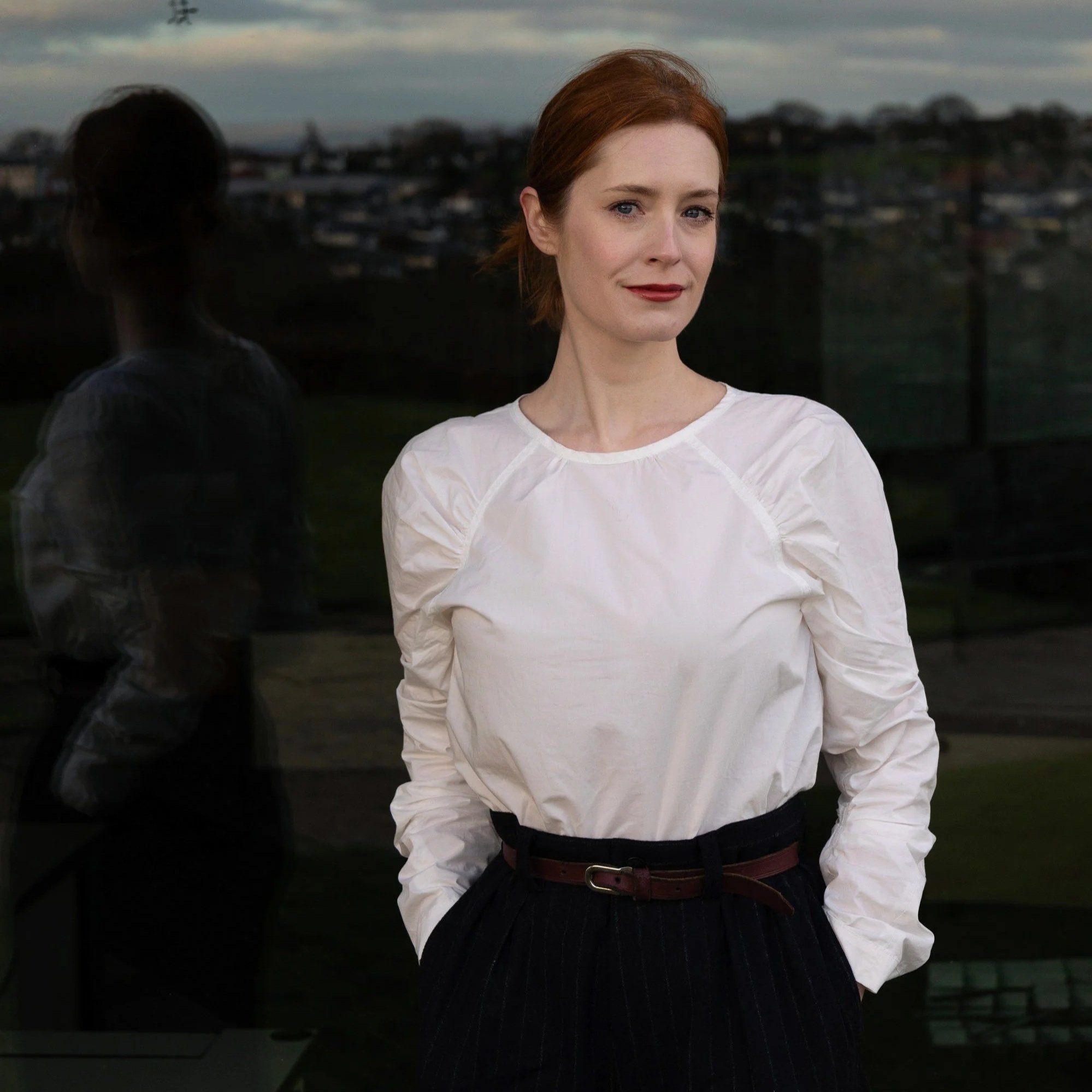
I meet journalist and author Gabriella Bennett in a car park in Glenrothes. Next to me, while I wait for her to arrive, a digger is slowly dismantling a brick building, leaving behind a pile of rubble akin to a bombsite. In the year her book How to Build a City is published, this post-war new town in which Gabriella grew up is itself going through a kind of re-imagining.
In the book, she takes the reader all around the world, from Helsinki to Japan, Ukraine to Texas, exploring how people create homes. For Gabriella, it all started here in Glenrothes, a town built in the shadow of the Second World War, in which art, architecture and the future collided.
When she pulls up, I jump in the passenger seat. What better way to see Glenrothes’ famous roundabouts and art works than with a driving tour from someone who spent their formative years here.
We began at St Paul’s church – an A-listed, blocky, white concrete building, which Gabriella calls ‘a really beautiful example of radical modernism’ – and I started by asking her how she came to grow up in this town.
Gabriella Bennet: ‘Up until the age of 12, [my childhood] was a very south coast, red brick, hot sun childhood. My dad bought houses and did them up. We lived in them at the time, sold them, and then moved on to the next place.
Me and my brother had never been to Scotland before. We drove up from the south coast in our little car, with our dog and our cat, and made this new life in this modernist pebbledash, concrete kingdom. It could not have been more different from where we had come from. It was such a culture shock.
It felt very lonely. I felt like an outsider for most of my childhood here. It was rough being an English kid in a Scottish town in the noughties. It was, I felt, pretty hostile. But it cultivated a certain feeling of outsideness that has really helped me as a writer. As a writer, you're always on the margins looking in, observing, which also helps in my job as a journalist.
Rebecca Smith: How did Glenrothes become the genesis of this book?
GB: I had this idea about the places that we live alongside shaping us. They're so important to understanding who we are as people. For years I never felt comfortable writing about Glenrothes, because I felt I'm not qualified enough. This isn't my hometown. I don't belong here. But now I understand it so much better. At some point everybody was new here. Everybody was an outsider and everyone’s got this interesting and slightly tenuous relationship with the town. I finally felt qualified or comfortable enough to say, actually, my opinion matters as well.
As she drives, we skirt numerous roundabouts. Many of them feature oversized sculptures. Gabriella points out four large flowers: irises, created in 1988, built with the notion that ‘big ideas can grow.’ On another roundabout: three elephants, created in 1973.
RS: How did Glenrothes and art become so entwined?
GB: When we were growing up, it was just part of Glenrothes. What's nice about the public art here is none of it is like plinth-bound or rare. All these artworks were sited in places where people lived and worked. So, in housing estates, roundabouts, industrial estates. And it was a deliberate thing to try and inject some identity.
RS: In the book, how did you get from here to writing about Ukraine, Texas, Japan and beyond?
GB: For many years, I thought I wanted to write a book about new towns. I thought it could be a kind of call to arms: why we should rebuild or recreate this idea of the postwar new town generation. It never felt quite right. And then when I started really interrogating that and thinking about it more deeply, I realised it was because I don't know how to feel about Glenrothes.
I didn’t know whether we should recreate the new town, because there's so many mistakes that were made. So, when I started working with Sophie [her agent], she encouraged me to think bigger, more global. I started to think about how else you can define experimental building, communities that have taken risks and tried to do something different. So that was my starting point.
It took me a long time to work out the structure of the book and how we would group together the places. But it seemed to happen quite naturally by the end. I talked to lots of different people, lots of different architects and designers, and tried to marshal my thoughts.
How to Build a City is split into three sections: ‘Rebuild for Peace’, ‘Rebuild for Planet’ and ‘Rebuild for People’. In the first of these sections, Gabriella writes about an underground city in Helsinki, built in the mid-20th century and large enough to shelter close to one million people in times of need. Containing playgrounds, gyms, museums – even an artificial lake – it continues to be used by Helsinki’s residents. I ask how Gabriella learned about this underground city.
GB: ‘I'd seen an article that had been written at the start of Russia’s full-scale invasion of Ukraine. I think Helsinki was trying to do a bit of . . . letting Russia know in a roundabout way that it had all its defences sorted, because the Finnish government invited journalists to write about the underground city. I think it was a tactical thing.
What surprised me was the people in Helsinki didn't see it as a defence strategy. They just used it for their shopping centres, or their subway systems, or going to the gym, the car park, the kindergarten, that amazing art gallery.
It reveals this slightly uncomfortable truth, which is, yes, it is there because you're so close to Russia. But it's also being brilliant in other ways and allowed the city to use that central district heating system and plan its reservoir and its pipes for electricity and water under the city, so you're not having to waste valuable space overground. It's genius. And it's eye-opening in a lot of ways.
RS: The other chapter in this section I want to ask about was Ukraine. Tell us what you found there.
GB: ‘The Ukraine chapter happened very quickly. I had an opportunity to go with Jen Stout [a Scottish Ukraine correspondent]. I didn't know when I might get a chance to go again. I felt really unprepared. I hadn't done conflict environment training and I just had to go into it completely green. But I know I write best when I am out of my comfort zone. And I wanted to really understand from this quite extreme place what it meant to rebuild while you were still being invaded and targeted. And it became clear that it wasn't just about shelter and survival in making homes for people, but it was an active and symbolic thing. This idea of resilience and of saying to the enemy that we won't be cowed, we won't be beaten into defeat. It's an act of hope and an act of trust in the future.
RS: You found yourself in bomb shelters after the siren had gone off a number of times.
GB: The bomb shelter experience was kind of strange because there are these air sirens that go off every day, multiple times a day, and they are designed to put your entire body on high alert.
The first time I heard one, I was having dinner on my own in Lviv, the first day I arrived. Raw panic goes through you. But in every situation like that, you're just always reminded that I get to go home. This is a two-week thing for me. I was stressed, I wasn’t sleeping. I was upset a lot because I found the content of the interviews very upsetting. But I knew this is something I need to report on.
I put it into perspective. And every time I felt scared or thought maybe I'll just get an earlier flight home. I was like, no, these people that I'm spending time with, they've dealt with this every day for four years. My experience doesn't really matter. And that's when the reporter side of your brain kicks in, and you can blend into the background, just be the observer, and let the real story shine and come to the front.
One especially fascinating part of the book is set in northern Sweden, in a town called Kiruna, where a church was transported five kilometres to protect it from unstable land. The project cost more than $50 million and was paid for by a mining company. It attracted international attention and, locally, criticism from some indigenous Sami people. The money, they felt, was misspent, and the company’s operations were disturbing traditional reindeer migration routes. How, I wondered, did this story find its way into the book?
GB: The Sweden chapter was interesting because, for this book, I wanted to report factually and truthfully. And I always want to find hope. I went into the Kiruna reporting trip thinking this was going to be this marvellous feat of engineering. And I left with this huge question mark. How was I going to write about this? Because the story I found was not hopeful. And it wasn't the chapter I thought I was going to write.
I found it difficult to not see Kiruna as a place of exploitation and of marginalised groups. And so, I wrote the chapter one way, I wrote the chapter another way. I concluded on one interview that wasn't quite right. The way it finishes now, with Nils-Johan Labba, the Sámi craftsman, that's quite a last-minute inclusion. But it had to be that. There's no way you can go and report on marginalised communities and indigenous communities and not have a voice from those communities.
What I found was that it's so important to go and do that boot-on-the-ground reporting. All the pieces about Kiruna I had read were the positive puff pieces. Isn't it great to have this 600-ton church moved five kilometres on this trailer? Of course, it’s a great thing. But it hid the real story for me, and it was only when I was able to whizz around Kiruna on my electric scooter, knocking on people's doors, that I actually found people that were willing to talk to me about the truth, which was they felt that their livelihoods were dwindling.
I would have completely missed that if I hadn't have gone. And as much as anything, the book is about giving a voice to those people, a voice to ways of life that are being swept away by modernity or the march of development.
RS: In ‘Rebuild for the Planet’ you visit Barcelona to learn how technology could protect cities from climate disaster.
GB: Yes, digital cities was one I was really looking forward to because I love to take the idea of something that is physical and real and move it into the more abstract or conceptual.
I don't know if you played the Sims when you were younger, but it was an absolute obsession for me. It was the idea of home and remaking home that I was just completely beguiled by. There was something about it that felt very cosy, but also full of jeopardy and excitement.
When I started researching what The Sims was and how it came to be, I discovered that it was created by Will Wright, the video game designer who lost his house in a firestorm in one of the 1991 California firestorms. He had to rebuild his place from scratch and then became really interested in the idea of reaccumulating belongings after disaster. He built The Sims from that.
It came from catastrophe, but it ended up meaning something to so many people. You don't have to go through disaster to enjoy [the game]. And that, to me, is the purest expression of art, rendering your experiences into something that other people can find communion in and saying, this is what it feels like for me. Drawing that invisible thread between one person and the next.
That expo [in Barcelona] was really interesting because it showed different ways of using technology to combat or confront disaster. But also understanding that it is building that has led us to this climate disaster. The construction industry accounts for more greenhouse gas emissions than any other industry. All these statistics lead us to the understanding that the traditional ways we've made cities are part of the problem, but actually, technology is one of the things that can help us.
RS: In ‘Rebuild for People’, you visit Austria and a city designed for women; Florida, to see communities for retirees; and Germany, to look at homes for refugees. But let’s focus on Japan and loneliness. You really immersed yourself in the research for this one, didn’t you?
GB: I'm naturally quite a lonely person. I think it's my personality, but also sometimes the job as a writer is very solitary and you have to spend time alone thinking inside your head in order to make your work. But this is a different kind of loneliness in Japan, the kind of chronic loneliness we understand to be a health condition.
Tokyo is home to 41 million people. So, I decided to try and go a whole day without speaking to anybody. Maybe this would be more difficult anywhere else but in Tokyo, which is so automated, so futuristic, so ruled by screens and robots and non-sentient beings, it was actually very easy. It started off as a novelty, and then by the end of the day, I felt very frazzled, and like you're missing something that you can't put your finger on.
RS: You end the book on Mars essentially, speaking to the communities who live near the rocket launches that one day could take the first communities to live in space. You’ve shown us how people rebuild during conflict, in peacetime, after climate disasters and proved that, really, all anyone really wants is to create a home. The reader is left with a real sense of hope.
GB: I'm glad because these are hefty subject matters we're dealing with: the loss of home, hostility against migration, gender discrimination, war, death, loneliness, and I wanted to be sure that while I handled those subject matters sensitively and honestly, I didn't want somebody to go away from this book thinking we're doomed and there's no way through because that's actually where a certain kind of paralysis starts. You start to feel disempowered and think, I can't change anything. What's the point in trying to do things differently?
What struck me, especially in Ukraine, were these small acts of defiance. Rebuilding Mariupol in a digital sense, storing and recording buildings and recreating them on a screen in order that, one day, when Mariupol falls back into Ukrainian hands, the city can be rebuilt and restored. These are acts of hope in the future. These are acts of trust that a different tomorrow is going to come.
It's not just important to rebuild, in a physical sense. It gives us something to hold onto. And it's a way of us saying, we have to keep going. There is no other choice. We have to keep going.